Costa Rica
![]()
Costa Rica is popular tourist destination in Central American, known for its many nature preserves and for being a stable democracy in a region where that historically hasn’t been the norm. Costa Rica has coast both along the Pacific Ocean and the Caribbean Sea, while bordering to Nicaragua in the north and Panama in the south. It has a fascinating geography.
Costa Rica is not a big country; with just above 51,000 square kilometers of landmass it is roughly the same size as Slovakia. It has a population of roughly 5 million people, of which approximately 2 million live in the sprawling San José metropolitan area, although only 350,000 or so are residents of the city proper.
The economy of Costa Rica was once heavily dependent on export crops such as coffee and bananas, but the situation is now more diversified with many Costa Ricans working in sectors such as finance, pharmaceuticals, tourism & hospitality, and corporate services for foreign companies. Free Trade Zones (FTZ) have been established to attract foreign investments.
Costa rica has an emerging binary options industry. The industry is growing quickly targetting the US as well as south and Central America
Costa Rica nature
Despite being such as small country, Costa Rica is home to an astonishingly high number of species – both flora and fauna. Almost 25% of Costa Rica’s land area consists of national parks or otherwise protected nature, although the degree of protection vary significantly, both legally and de facto. Deforestation is a problem and less than 4% of Costa Rica is now covered in primary forest.
The ecotourism sector in Costa Rica started growing significantly in the 1980s and towards the end of the 20th century Costa Rica had become somewhat of a poster child for tropical nature-centered tourism, with its dry-, rain- and cloud forests, volcanic landscapes, bird-rich wetlands, and thriving coral reefs.
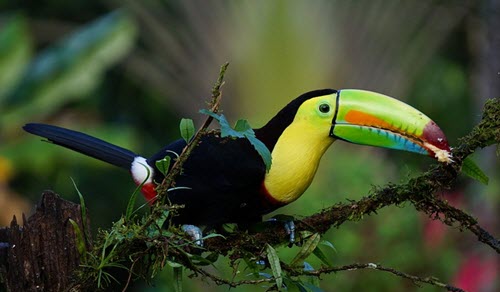
Over 12,000 plant species are known to live in Costa Rica, of which roughly 950 are endemic to the country. There are over 830 species of birds, 440+ species of amphibians & reptiles, 230+ mammal species, and over 180 species of freshwater fish.
Climate
Located between 8 and 12 degrees north of the equator, Costa Rica is a tropical country dominated by warm weather. There are many factors impacting the weather though, such as elevation and topography, and Costa Rica features a wide range of microclimates.
The mean annual temperature is circa 27 °C in the coastal lowlands, but only 20 °C in the areas of Cordillera Central where most of Costa Rica’s population lives.
Generally speaking, the rainy season in Costa Rica starts in May and ends in November. Some parts of the country will however be rainy year-round or almost year-round due to local conditions.
One of the wettest parts of the country is the Caribbean slopes of the Cordillera Central, where you can expect over 5,000 mm of precipitation in an average year.
Volcanoes
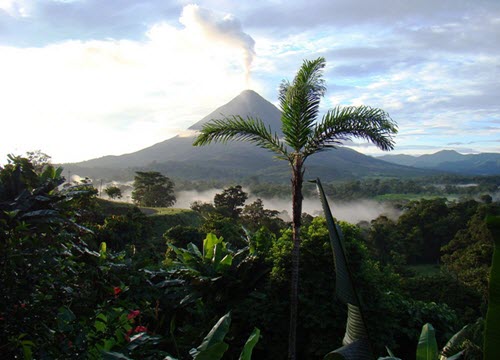
Costa Rica is home to several volcanoes, both dormant and active ones.
Here are a few examples:
🌋
Major Volcanoes of Costa Rica: Geological Fact Sheet
Central American Volcanic Arc (CAVA) cordillera summits, coordinates, elevation benchmarks, and eruption records
Highest Volcanic Peak
Volcán Irazú
3,432 m (11,260 ft)
Most Restless Eruptors
Poás & Rincón
Recurring phreatic activity (2024–2026)
Iconic Stratovolcano
Volcán Arenal
Resting phase since 2010
Monitoring Authority
OVSICORI-UNA
Continuous seismic & gas telemetry
| Volcano Name |
Coordinates |
Summit Elevation |
Most Recent Eruptive Activity |
|
Arenal
Stratovolcano
|
10.463°N • 84.703°W
|
1,670 m (5,479 ft)
|
2010 (continuous Strombolian cycle begun in 1968 ended in Dec 2010)
|
|
Barva
Complex Stratovolcano
|
10.135°N • 84.100°W
|
2,906 m (9,534 ft)
|
6050 BCE (dormant Holocene crater lakes)
|
|
Cerro Tilarán
Volcanic Field
|
10.451°N • 84.978°W
|
634 m (2,080 ft)
|
Pleistocene Epoch (extinct structural relief)
|
|
Irazú
Stratovolcano (Shield-like)
|
9.979°N • 83.852°W
|
3,432 m (11,260 ft)
|
1994 (famous 1963–1965 Plinian cycle covered San José in ash)
|
|
Miravalles
Stratovolcano
|
10.784°N • 85.153°W
|
2,028 m (6,653 ft)
|
1946 (small steam explosion; primary geothermal energy field)
|
|
Orosí
Stratovolcano
|
10.980°N • 85.473°W
|
1,659 m (5,443 ft)
|
Circa 3,500 years ago (eroded volcanic complex in Guanacaste)
|
|
Platanar
Stratovolcano
|
10.300°N • 84.366°W
|
2,267 m (7,438 ft)
|
Holocene Epoch (undated prehistoric post-glacial eruptions)
|
|
Poás
Stratovolcano
|
10.200°N • 84.233°W
|
2,708 m (8,884 ft)
|
2024–2026 (Active)
Frequent phreatic & gas eruptions through hyper-acidic Laguna Caliente (major cycles: 2017, 2019, 2024–2026).
|
|
Rincón de la Vieja
Complex Volcano
|
10.830°N • 85.324°W
|
1,916 m (6,286 ft)
|
2023–2026 (Active)
Ongoing hydrovolcanic explosions, ash plumes, and river lahars recorded frequently throughout 2023, 2024, 2025, and 2026.
|
|
Tenorio
Complex Stratovolcano
|
10.673°N • 85.015°W
|
1,916 m (6,286 ft)
|
Unknown in historical times (active hydrothermal system feeds Río Celeste’s blue waters)
|
|
Turrialba
Stratovolcano
|
10.025°N • 83.767°W
|
3,340 m (10,958 ft)
|
2022 (frequent ash and gas venting 2014–2020, with minor eruptive events continuing through July 2022)
|
Tectonic Context: Costa Rica’s volcanoes are formed by the subduction of the Cocos oceanic plate beneath the Caribbean tectonic plate along the Middle America Trench. Real-time seismic alerts, crater-lake pH levels, and exclusion zones are updated continuously by the Observatorio Vulcanológico y Sismológico de Costa Rica (OVSICORI-UNA) and the Comisión Nacional de Emergencias (CNE).
🇨🇷
Short Facts About Costa Rica (República de Costa Rica)
Geographic profile, administrative governance, sovereignty timeline, and demographic overview
Capital & Largest City
San José
9°56′N 84°5′W
Total Land Area
51,100 km²
(19,700 sq mi • 0.7% water)
Official Currency
Colón (CRC)
Symbol: ₡
Independence Declared
15 Sept 1821
From the Spanish Empire
| Attribute |
Details & Key Specifications |
| Official Name |
Republic of Costa Rica (República de Costa Rica)
|
| Government Type |
A unitary presidential constitutional republic
|
| Capital & Largest City |
San José (Coordinates: 9°56′N 84°5′W)
|
| Total Area |
51,100 sq km (19,700 sq mi) • 0.7% water coverage
|
| Demonym |
Costa Rican • Informally: Tico (masc.) / Tica (fem.)
|
| Languages |
Official: Spanish
Recognized Regional Languages: Mekatelyu (Limonese Creole), Bribri, Patois
|
| Independence History |
- From Spain: Declared 15 September 1821
- From the First Mexican Empire: Declared 1 July 1823
- From the Federal Republic of Central America: Declared 1838
|
| Currency |
Costa Rican colón (CRC)
|
| Time Zone & Calling Code |
Time Zone: CST (UTC -6) • Calling Code: +506
|
| Domains & Standards |
ccTLD: .cr, .co.cr • ISO 3166 Code: CR • Driving Side: Right
|
| Legal & Regulatory Status |
- Gambling: Legal (regulated land-based casino operations and international offshore gaming servers)
- Prostitution: Legal and widespread. Requires license. (Pimping, operating brothels, and human trafficking remain illegal offenses under the penal code)
|
Sovereignty Context: Following independence from the Spanish Empire alongside the rest of Central America in 1821, Costa Rica was briefly annexed into the First Mexican Empire before joining the Federal Republic of Central America. In 1838, the nation formally withdrew to establish itself as a fully independent sovereign republic.